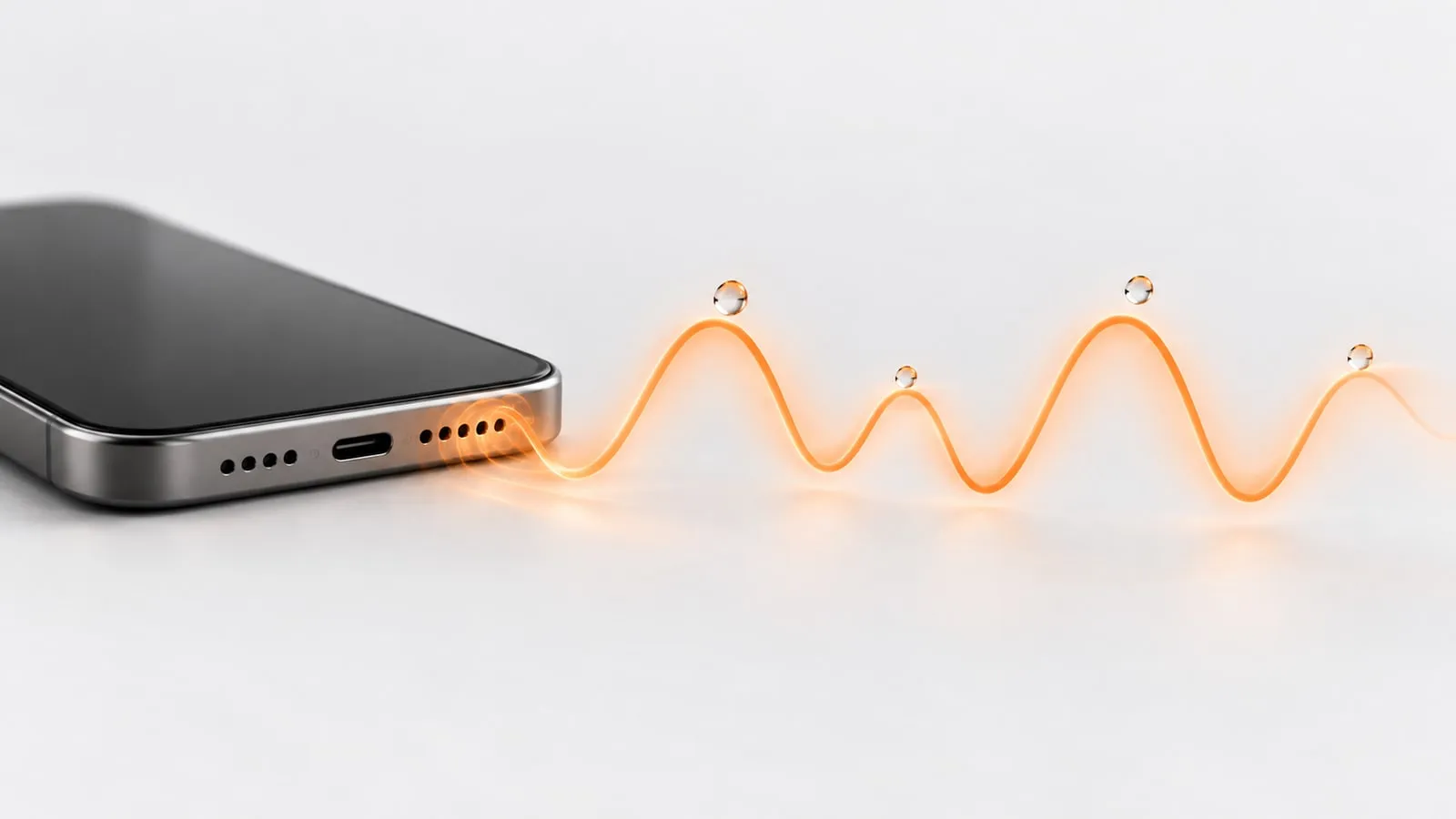
The speaker cleaner frequency that works best for water is a low tone around 165 Hz, played at full volume in short pulses. It is low enough to move the speaker diaphragm a long way, which pushes air through the grille, and high enough that a tiny phone speaker can still play it at a useful level. Dry dust responds better to a sweep through roughly 200 to 1200 Hz, and the small earpiece needs a gentler, higher range.
You can play the 165 Hz pulse now with the water eject sound. It runs in your browser for 60 seconds with no app or download. The reasoning behind each number is below.
What a speaker cleaner frequency has to do
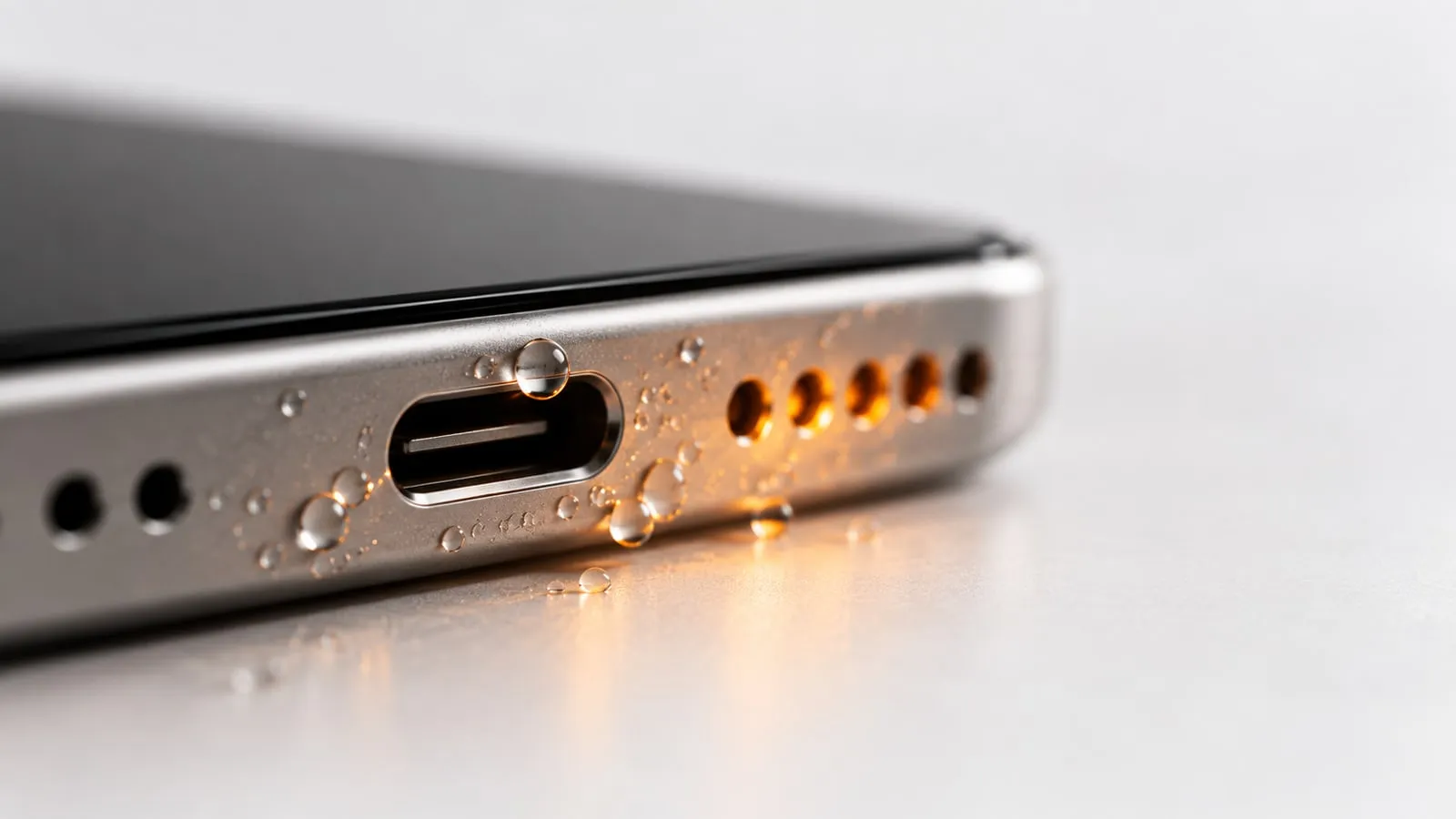
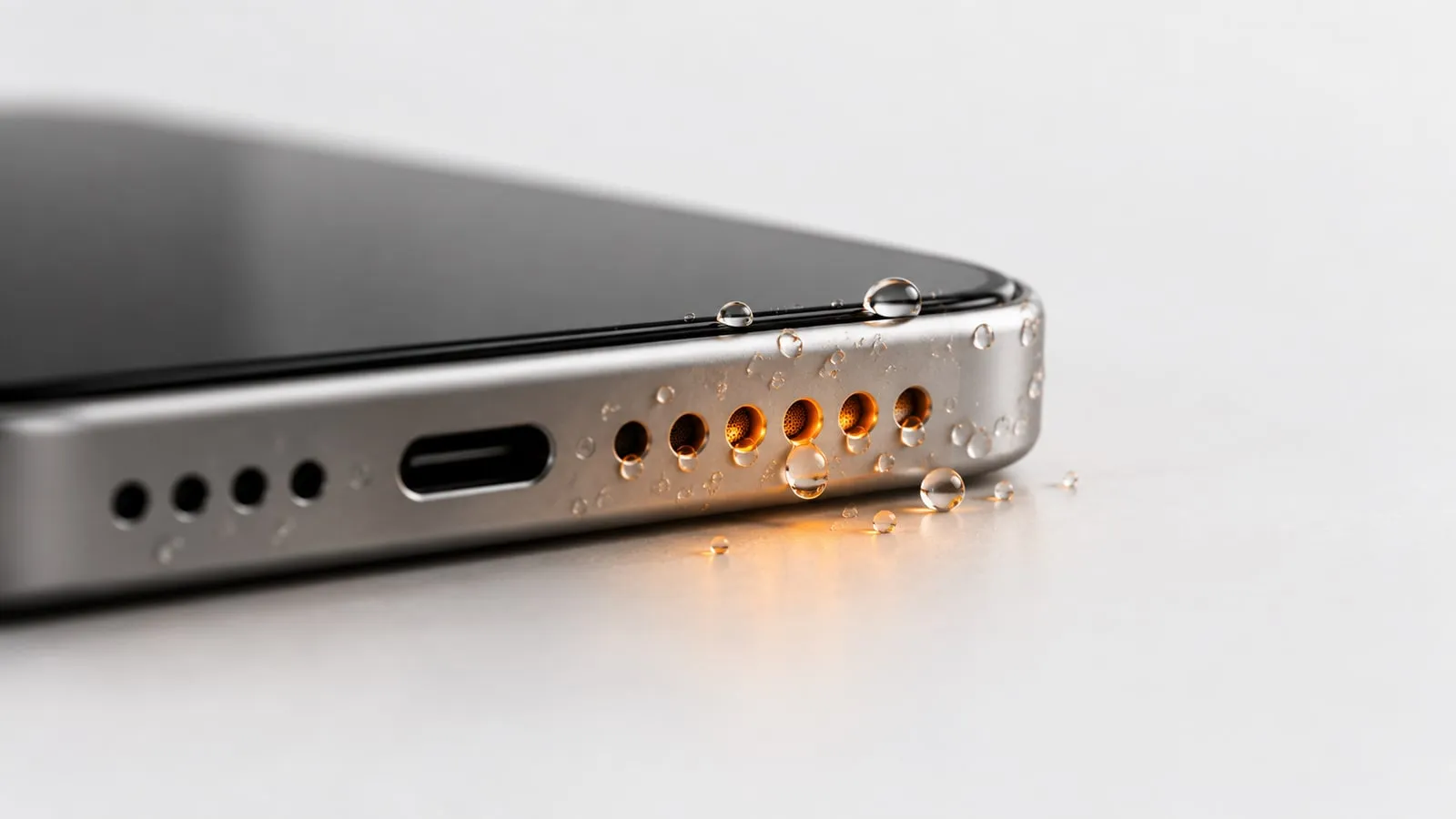
Water in a phone speaker usually sits in the grille: a fine mesh just in front of the speaker. Surface tension holds droplets in the mesh holes, and they block the air path, which makes sound muffled or crackly.
To clear them, the sound has one physical job: move enough air through the small chamber behind the grille to push the droplets out. The volume of air a speaker moves depends on how far its diaphragm travels on each stroke, called excursion. So the best cleaning frequency is the one that gets the most excursion out of a phone speaker. Two limits decide where that is.
Why around 165 Hz is the sweet spot
Limit 1: high frequencies barely move the diaphragm
In the textbook model, a speaker diaphragm has to move about four times as far every time the frequency is halved to keep the same loudness. Turned around, excursion shrinks fast as frequency rises. A 330 Hz tone moves the diaphragm about a quarter as far as a 165 Hz tone at the same loudness, and by 10000 Hz the movement is tiny.
This is why high-pitched “cleaner” videos don’t work. The full myth is covered in speaker cleaner 10000 Hz and 20000 Hz. The short version: lower is better, up to a point.
Limit 2: tiny speakers can’t play deep bass
Phone speakers are micro speakers in very small enclosures, and their output drops steadily as the pitch goes down. One patent on micro speaker design gives an example: a speaker in a 1 cubic centimeter enclosure could lose output significantly below about 800 Hz. Real phones differ, but the pattern is the same. Some phones also use a “smart amplifier” that monitors excursion and temperature and limits the signal to protect the speaker.
In practice, a 50 Hz tone on a phone is faint, and the phone’s own protection may turn part of it down. You get less useful air movement, not more.
The window between the two
Put the two limits together and you get a compromise. Go too high and the diaphragm barely moves. Go too low and the speaker can’t play the tone with any strength. Water eject tools settle in the low hundreds of hertz, and 165 Hz has become a common choice.
There is nothing magic about exactly 165. A tone at 150 Hz or 180 Hz behaves much the same. It is a practical choice that works on real phones, not a precisely calculated optimum.
Why the water tone pulses
The Water mode doesn’t play a steady hum. It plays a 165 Hz sine wave at full level for about 0.48 seconds, drops to a low level for about 0.12 seconds, and repeats that cycle for 60 seconds.
The reasons are practical:
- Fresh pushes. A droplet held in a mesh hole by surface tension can settle into a steady vibration. Each time the tone comes back up, the droplet gets a new jolt, and a series of jolts has a better chance of breaking it free.
- Time to drain. In the short dip, loosened water has a moment to move out of the mesh and fall away, especially with the speaker facing down.
- Short bursts. The speaker never plays one long, unbroken tone at full level.
This is a design choice, not a law of physics. Apple Watch works on a similar idea: turning off Water Lock plays a series of tones to clear water from the speaker.
Why a sine wave for water
A sine wave puts all its energy at one frequency, so the whole output stays at 165 Hz, where excursion is large. A square or sawtooth wave at the same pitch adds a stack of higher overtones, and those higher parts move the diaphragm less and mostly add harshness.
Why dust needs a sweep instead
Dust and lint behave differently from water. A dry particle isn’t held by surface tension. It is wedged against the mesh or resting in the chamber, and particles of different sizes respond to different frequencies.
A single tone favors one kind. A sweep passes through a whole range, which gives more of the particles a chance to shake loose. That is why the Dust mode uses:
- a sawtooth wave, which adds strong overtones and a buzzy vibration that rattles loose debris,
- a sweep from 200 to 1200 Hz and back, rising and falling every 6 seconds,
- a 60-second run.
Sound only moves loose, dry particles. Packed lint or sticky grime needs gentle physical cleaning. See how to clean dust out of a phone speaker for safe methods.
Why the earpiece gets a higher, gentler range
The earpiece (the small speaker at the top you hold to your ear on calls) is much smaller than the bottom speaker and is built to play voice close to your ear, not fill a room. Driving it with the same loud, low 165 Hz pulse makes little sense.
The Ear speaker mode uses a sine sweep from 400 to 1500 Hz over 45 seconds, at a lower level than the other modes. Sine keeps it smooth, and the higher range suits the smaller driver. For the full routine, including how to clean the earpiece mesh by hand, see how to clean the earpiece speaker.
Every speaker cleaner mode at a glance
| Mode | Frequency | Wave | Duration | Best for |
|---|---|---|---|---|
| Water | 165 Hz, pulsing (about 0.48 s on, 0.12 s low) | Sine | 60 seconds | Water droplets in the bottom speaker |
| Dust | 200 - 1200 Hz sweep, up and down every 6 s | Sawtooth | 60 seconds | Loose, dry dust and lint |
| Deep clean | Phase 1: 165 Hz pulse. Phase 2: 100 - 800 Hz sweep. Phase 3: bursts alternating 140/220 Hz | Sine, then sawtooth, then square | 2 minutes | Water plus dust, or a stubborn case |
| Ear speaker | 400 - 1500 Hz sweep | Sine | 45 seconds | The small top earpiece |
| Manual | Any value from 80 - 1000 Hz | Sine, square, saw or triangle | Until you stop it (auto-stop at 5 minutes) | Testing your own settings |
| Speaker test | Left, right, both, plus a 20 Hz - 20 kHz sweep | Sine | 2.5 s per channel tone, 14 s sweep | Checking both speakers after cleaning |
In Deep clean, the three phases run back to back: about 40 seconds of the 165 Hz pulse, 50 seconds of the 100 to 800 Hz sawtooth sweep, then 30 seconds of square-wave bursts that switch between 140 and 220 Hz four times a second.
Choosing a frequency in Manual mode
If you want to experiment, Manual mode gives you the controls. Some starting points:
- Water: sine wave, 150 to 200 Hz. Stay low.
- Stubborn water: square wave, 140 to 220 Hz. The overtones add a harder buzz.
- Dust: sawtooth wave, 300 to 800 Hz. Move the slider slowly through the range.
- Earpiece: sine wave, 400 Hz or above, at a lower volume.
Manual mode stops at 1000 Hz because above that the diaphragm moves too little to help, as explained earlier.
How to play the 165 Hz tone for the best result
- Turn off silent mode. On iPhone, use the Ring/Silent switch. On iPhone 15 Pro, iPhone 16 and later, which have an Action button instead, use Control Center or the Action button. On Android, turn off Do Not Disturb.
- Disconnect Bluetooth headphones or speakers.
- Set the media volume to maximum.
- Hold the phone with the bottom speaker facing down.
- Open the water eject sound and tap start.
- Let it run the full 60 seconds, then wipe the grille with a lint-free cloth.
- Repeat two or three times and check the sound with music or a video.
On Android, you can turn on vibration in the tool for a little extra shaking. iPhones block vibration for websites, so on iPhone only the sound does the work.
When the right frequency still isn’t enough
Frequency can only do so much. If three or four rounds at 165 Hz don’t change the sound, the cause is probably out of reach:
- Moisture deeper inside the phone. Let it air dry in a spot with airflow, not in rice and not with a hair dryer. Apple says a wet connector can take up to 24 hours to dry fully. Our step-by-step guide to water in a phone speaker covers the full process.
- Sticky or salty residue. Soda, coffee and seawater leave deposits that sound won’t move.
- Damaged hardware. If the speaker still crackles at every volume after it is fully dry, or one speaker is silent in a speaker test, a repair shop needs to look at it.
If you haven’t tried it yet, start with the basics: phone speaker down, volume up, and two or three rounds of the 165 Hz water eject sound.
Sources
- Autoimage: Subwoofer enclosures, more than just a box (excursion vs frequency)
- Google Patents: US9118992B2, ported enclosure and equalization in a micro-speaker audio system
- Texas Instruments: TAS2559 smart amplifier with thermal and excursion protection
- Apple Support: How to use Water Lock and eject water from your Apple Watch
- Apple Support: If you see a liquid-detection alert on your iPhone
- Apple Support: Use the Action button, side button, and other controls on your iPhone