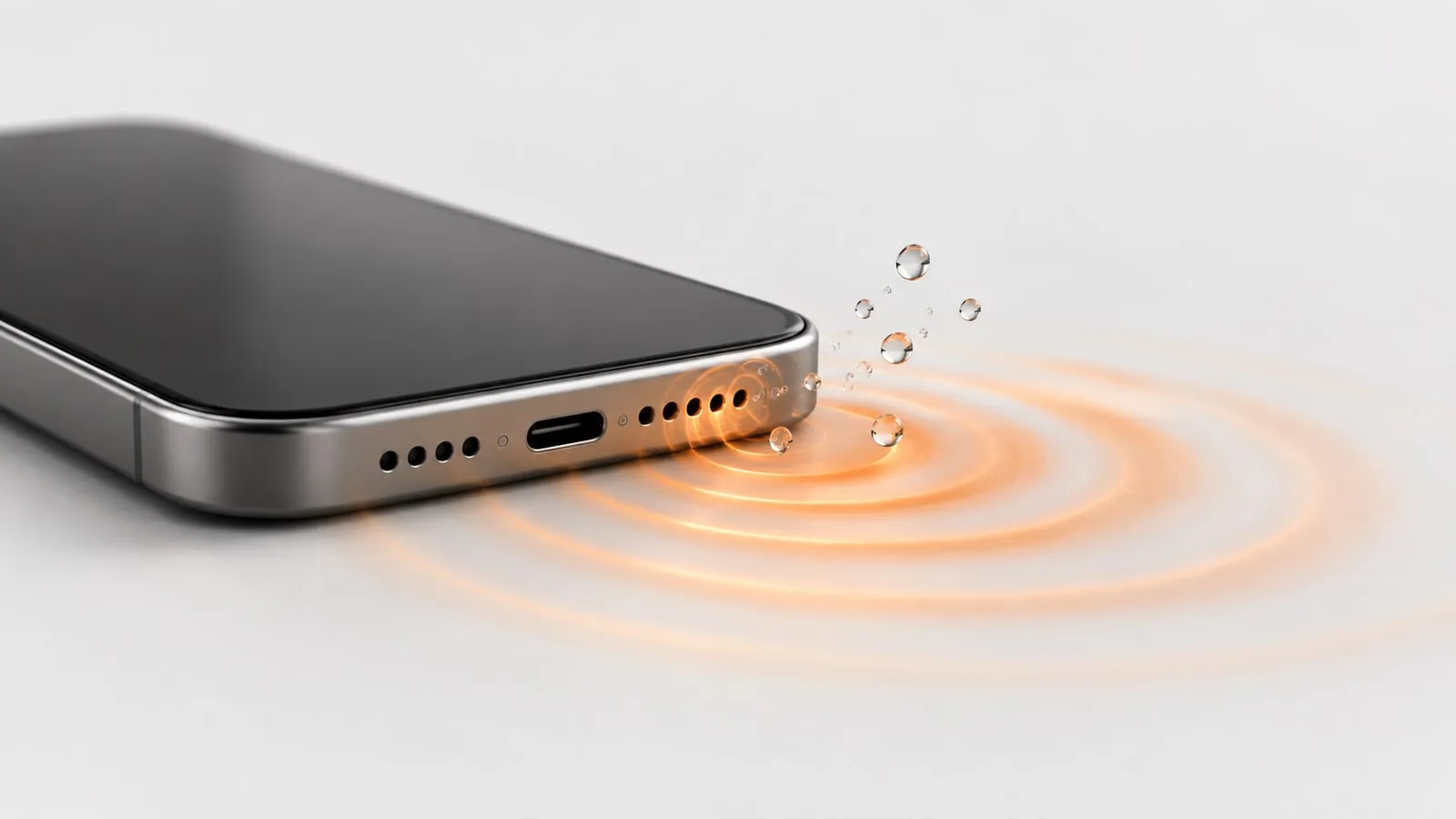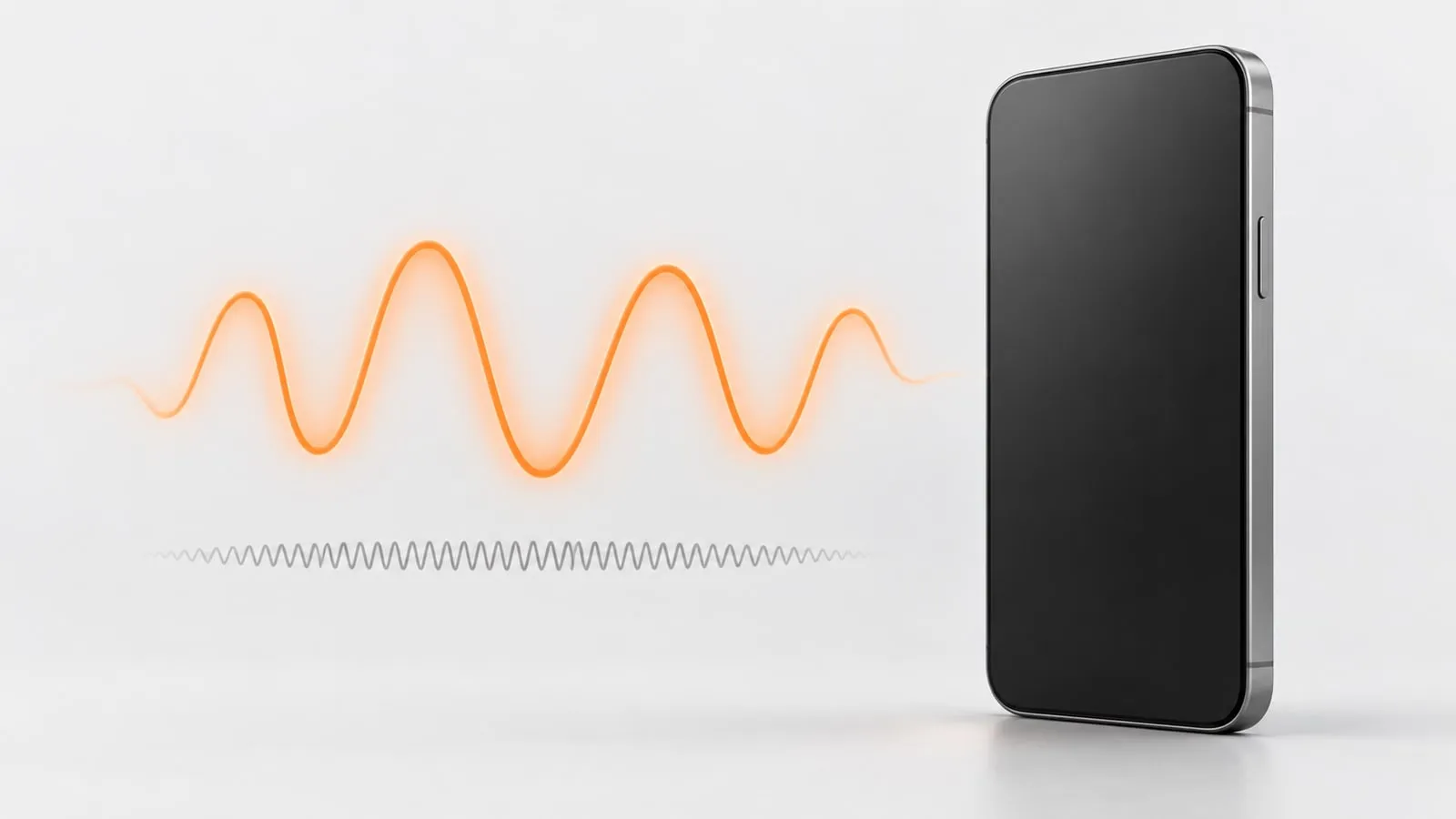
A speaker cleaner sound at 10000 Hz, 20000 Hz or higher will not clean your phone speaker in any useful way. The higher the frequency, the less the speaker diaphragm moves, so a high-pitched tone pushes almost no air through the grille. Tones like 30000 Hz and 50000 Hz go further: a normal phone and a normal video cannot even play them. Low tones around 165 Hz are what actually move water.
If you want a tone that works, the phone speaker cleaner sound tool plays a pulsing 165 Hz water tone and a 200 to 1200 Hz dust sweep, generated live in your browser. Its Manual mode lets you choose any frequency from 80 to 1000 Hz. The slider stops at 1000 Hz on purpose, and the reasons are below.
Where the 10000 Hz and 20000 Hz speaker cleaner trend comes from
Search TikTok or YouTube for “speaker cleaner” and you will find videos titled 10000 Hz, 20000 Hz, 30000 Hz and even 50000 Hz. A number in the title makes them look scientific, and a piercing tone feels like it must be doing something.
A likely source of the confusion is ultrasonic cleaning, which is real. Jewelry and lab cleaners use ultrasound, usually from 20 to 40 kHz, to create tiny collapsing bubbles in a liquid bath. That process needs a powerful transducer and a tank of liquid. A phone speaker playing into open air is a completely different situation, and it can’t reproduce those frequencies anyway.
Why higher frequency means less speaker movement
A speaker makes sound by moving its diaphragm back and forth. How far it moves on each stroke is called excursion.
In the simple textbook model, excursion follows one rule at a given loudness: halve the frequency and the diaphragm must move about four times as far. Double the frequency and it moves about a quarter as far.
Run that rule from 165 Hz upward:
- 330 Hz: about 1/4 of the movement
- 660 Hz: about 1/16
- 1320 Hz: about 1/64
- 2640 Hz: about 1/256
- 5280 Hz: about 1/1,024
- 10560 Hz: about 1/4,096
By that model, a tone near 10000 Hz moves the diaphragm roughly four thousand times less than a 165 Hz tone at the same loudness. Treat the exact figure as a rough approximation: real phone speakers, with their tiny enclosures and protective amplifiers, don’t follow the model closely. The direction holds, though. High tones move the diaphragm far less. They sound loud and piercing because human hearing is most sensitive in the upper midrange (roughly 2,000 to 5,000 Hz) and still keen above it, not because the speaker is moving much air.
Pushing a water droplet out of a mesh hole needs air movement, and air movement comes from excursion. High-frequency cleaners have very little of it.
What your phone can actually play
Even if high tones did work, there is a hard ceiling on what a phone can produce.
The sample rate sets a limit
Digital audio is stored as a series of samples. The highest frequency a sample rate can represent is exactly half of it, called the Nyquist frequency. Phone and web audio usually run at one of two sample rates:
| Sample rate | Highest possible tone (Nyquist) |
|---|---|
| 44,100 Hz (44.1 kHz) | 22,050 Hz |
| 48,000 Hz (48 kHz) | 24,000 Hz |
A 30000 Hz or 50000 Hz tone is above both limits. It can’t be represented in that audio at all. In browsers, the Web Audio API sets the maximum oscillator frequency at the Nyquist frequency, so a website can’t generate a real 50000 Hz tone on a normal 48 kHz audio device either.
The speaker itself falls off
Phone speakers are tuned for voices, ringtones and music. Output near the top of the audible range is often weak, and the exact behavior differs from phone to phone. Even when a 15000 to 20000 Hz tone technically plays, there is often little energy behind it.
Can you even hear these tones?
Human hearing is usually given as 20 to 20,000 Hz, with a lot of variation between people at the top end. Sensitivity to high frequencies declines gradually with age, and in adults the hearing threshold rises sharply around 15 kHz, so many adults can’t hear tones much above that.
That matters for these videos. If you play a “20000 Hz speaker cleaner” and hear nothing, the tone may not be there at all, your speaker may not be producing it, or you may simply not hear it. None of those outcomes cleans anything.
Why a video can’t carry a 20000 Hz or 50000 Hz tone
There is one more filter between the video creator and your speaker: audio compression.
Video platforms compress audio with lossy codecs such as Opus and AAC, and lossy codecs throw away the frequencies people are least likely to notice, starting at the top.
- The Opus codec specification states that Opus never codes audio above 20 kHz, because that is the generally accepted upper limit of human hearing.
- An independent analysis of YouTube audio found the Opus stream removed essentially everything above 20 kHz, and the AAC stream cut the high end off just under 16 kHz.
So a “50000 Hz” video cannot contain a 50000 Hz tone, and a “20000 Hz” video may reach you with the tone partly or fully removed. Whatever you hear is something else: a lower tone, distortion or compression artifacts.
Speaker cleaner frequencies: what actually happens
| Frequency | Can a phone play it? | Can most people hear it? | Diaphragm movement | Useful for cleaning? |
|---|---|---|---|---|
| 165 Hz (pulsing sine) | Yes, clearly | Yes | Large for a phone speaker | Yes, the standard water tone |
| 200 to 1200 Hz sweep | Yes | Yes | Moderate | Yes, for loose dust |
| 10000 Hz | Yes | Yes, as a sharp whine | Very small (roughly 1/4,000 of 165 Hz in the textbook model) | No |
| 15000 to 20000 Hz | Weakly, varies by phone | Many adults can’t | Tiny | No |
| 20000 Hz in a video | Often removed or reduced by compression | Rarely | Tiny or none | No |
| 30000 Hz | No, above 22.05/24 kHz limits | No | None | No |
| 50000 Hz | No | No | None | No |
Is a 10000 Hz tone harmful?
For the speaker, a short 10000 Hz tone is unlikely to cause harm, because the diaphragm barely moves at that frequency. For your ears, it is a different story. A loud, piercing tone at full volume near your head is unpleasant and not good for your hearing. Keep the phone at arm’s length and don’t loop these videos.
The real cost is time. While a high tone plays and does nothing, the water stays in the grille.
What to use instead
Use a tone that moves the diaphragm and that your phone can play at a useful level:
- Water mode: a 165 Hz sine tone that pulses (about half a second on, then a short dip) for 60 seconds. Best for droplets after rain, a spill or a swim.
- Dust mode: a sawtooth sweep that rises from 200 to 1200 Hz and back every 6 seconds, for 60 seconds. Better for dry dust and lint.
- Manual mode: pick any frequency from 80 to 1000 Hz and a wave shape (sine, square, saw or triangle). Useful if you want to experiment, and capped at 1000 Hz because higher tones do less.
Why 165 Hz and not 50 Hz or 500 Hz is its own topic. We explain it in speaker cleaner frequency: why 165 Hz.
For best results, set volume to maximum, turn off silent mode, disconnect Bluetooth headphones and hold the phone with the speaker facing down. If you are not sure a low tone is safe either, see does a speaker cleaner work and is it safe.
If a low tone doesn’t fix it either
Switching from 10000 Hz to 165 Hz is often enough for a wet speaker within a few rounds. If it isn’t, the problem is probably out of reach for sound:
- Water deeper inside: let the phone air dry in a spot with airflow for up to a day, then try again. Our guide to water in a phone speaker walks through it step by step.
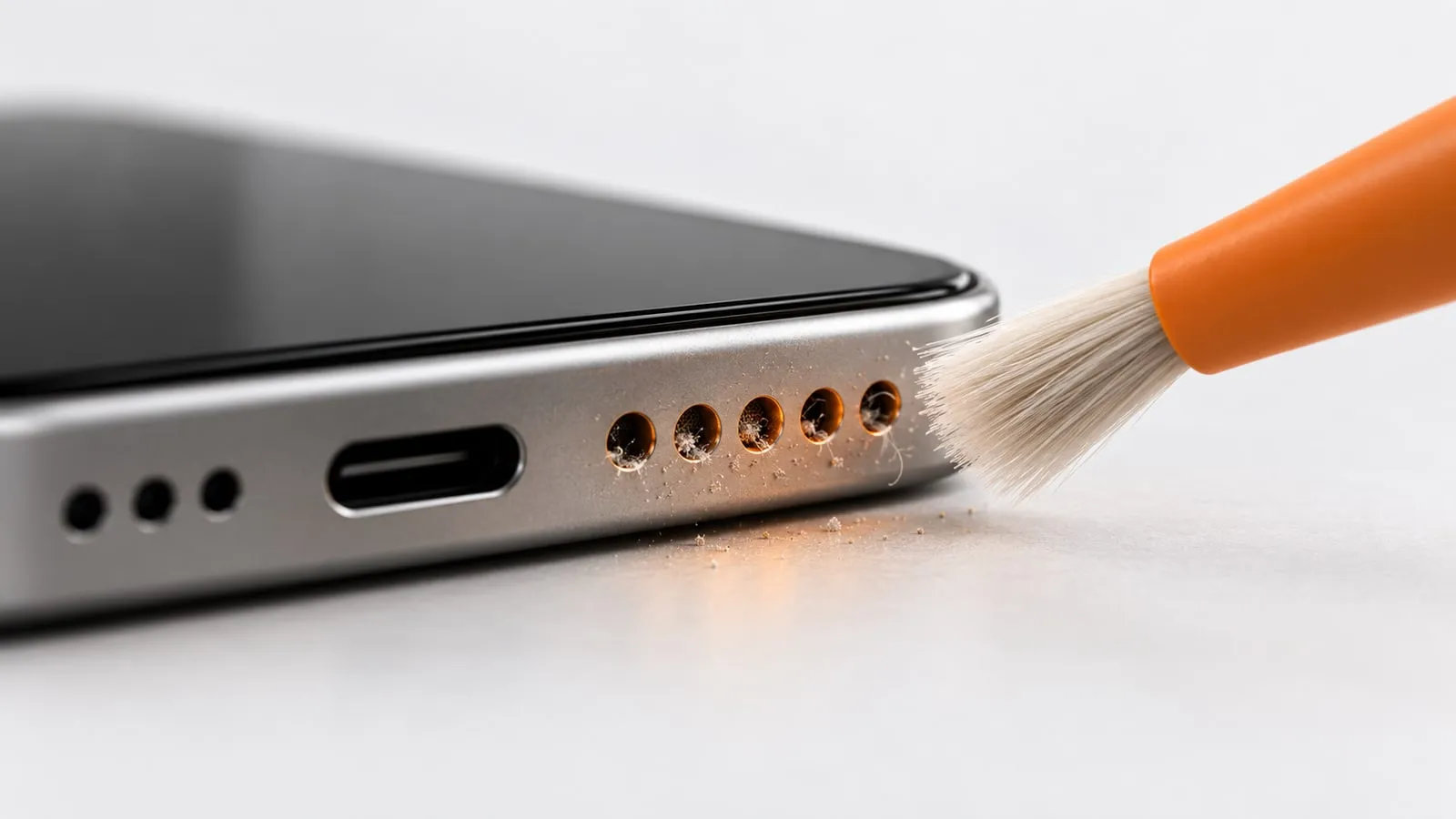
- Packed dust or lint: sound can’t loosen compacted debris. Brush the surface gently, and if the holes still look solid, let a repair shop clean it. See how to clean dust out of a phone speaker.
- Distortion that stays after drying: crackling at every volume level, or one speaker much quieter than the other, points to hardware damage. Run a speaker test and take the phone to a repair shop if it fails.
When you are ready to try a frequency that actually does the work, open the phone speaker cleaner sound and start with Water mode.
Sources
- Wikipedia: Nyquist frequency
- W3C: Web Audio API specification (OscillatorNode frequency range)
- IETF RFC 6716: Definition of the Opus Audio Codec
- AudioMisc: YouTube audio quality analysis
- Wikipedia: Hearing range
- Wikipedia: Presbycusis
- Wikipedia: Ultrasonic cleaning
- Autoimage: Subwoofer enclosures, more than just a box (excursion vs frequency)